Hardly anything on the playground gets kids lining up faster than a zip line.
You can feel the buzz right away. The nervous excitement on the platform, the cool whirr of the wheel as you take off, and that fun little bounce when you hit the stopper at the end.
It feels like zip lines have always been at the park, but they actually started as a way to haul heavy gear across giant mountains! Here is the wild story of how a serious mountain tool turned into the ultimate playground ride.
Long before anyone zip-lined for fun, high-flying cables were purely about survival.
Going as far back as 2500 BCE (over 4,000 years ago!), people living in rugged places like the Himalayas, the Andes, and China’s Nujiang River valley built the very first versions.
They didn't have steel cables or smooth rolling wheels, just thick ropes woven from hemp or plant vines stretched across giant canyons and wild rivers. Where building a bridge was impossible, these simple ropes were absolute lifelines for hauling food, tools, and villagers across massive drops.
Publication: National Geographic Magazine (February 2021 Issue / Published online January 12, 2021)
Article Title: "In this remote corner of China, locals use zip lines to get around"
Photographer: Fritz Hoffmann
Subject / Caption: Lisu villager Nan Boyi hauling a cow across a zip line cable over the rushing Nu River (Salween River) gorge in Yunnan, China.
Riding a wire just for the thrill isn't a modern invention; people were trying it centuries ago, though it was a lot more dangerous back then!
Back in 1739, a daredevil named Robert Cadman put on a wild show in Shrewsbury, England. He tied an 800-foot rope to the top of a 220-foot church spire and slid all the way down to the riverbank while a crowd watched in shock.
It was a far cry from today's ultra-safe equipment, but the basic formula was already set: gravity, speed, and a whole lot of adrenaline.

St Mary's Church, Shrewsbury
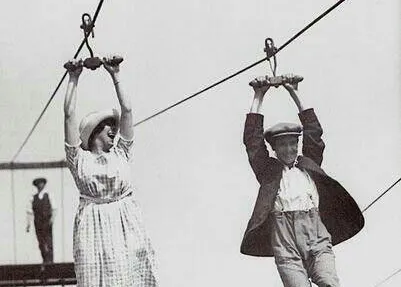
Zip lines first hit play spaces in the 1940s and 50s with Britain’s "adventure playgrounds", open-air sites stocked with raw materials like telephone poles, rope, and steel pulleys.
The kids' absolute favourite build? Homemade zip lines. They’d stretch wire between trees, grab a makeshift handle, and crash-land onto old mattresses or sand.
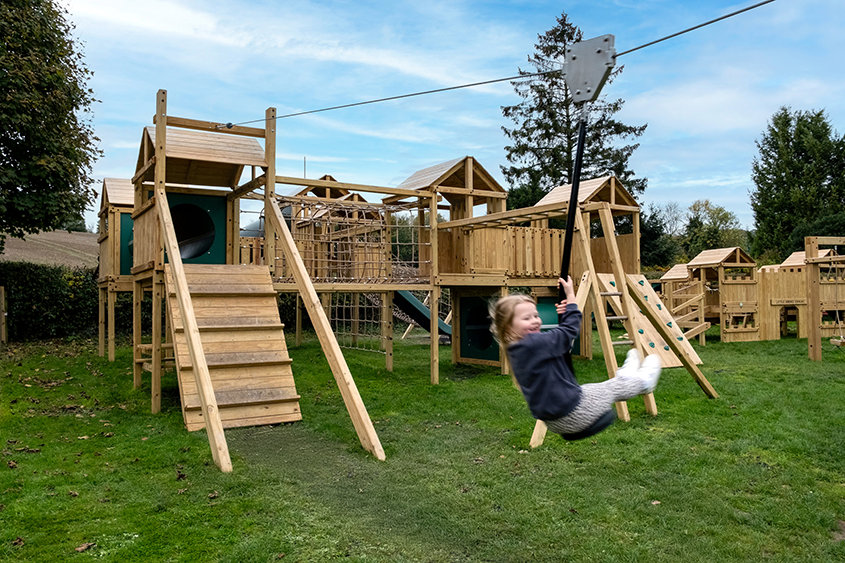
By the 1980s and 90s, public parks wanted that same thrill without the risky landings. Equipment makers took the idea and upgraded it for safety, swapping DIY rigs for sturdy timber frames, covered wheels, and soft rubber seats.
From ancient mountain lifelines to modern park favourites, the zip line has come a long way. Next time you see a queue forming at the playground, you’ll know the amazing history behind every whirr and bounce!
Ancient Rope Cables: Needham, J. (1971). Science and Civilisation in China: Volume 4, Physics and Physical Technology. Cambridge University Press.
Incan Mountain Transport: UNESCO Intangible Cultural Heritage (2013). Knowledge, skills and rituals related to the annual renewal of the Q’eswachaka bridge (Ref No. 00594).
Robert Cadman’s Flight (1739): Oxford Dictionary of National Biography (Robert Cadman, 1711–1739) & St Mary’s Church Monument, Shrewsbury, UK.
Adventure Playgrounds: Lady Allen of Hurtwood (1968). Planning for Play. MIT Press / National Playing Fields Association.
Modern Playground Safety Standards: European Committee for Standardisation (EN 1176) & ASTM International (F1487 Standards for Playground Equipment).